


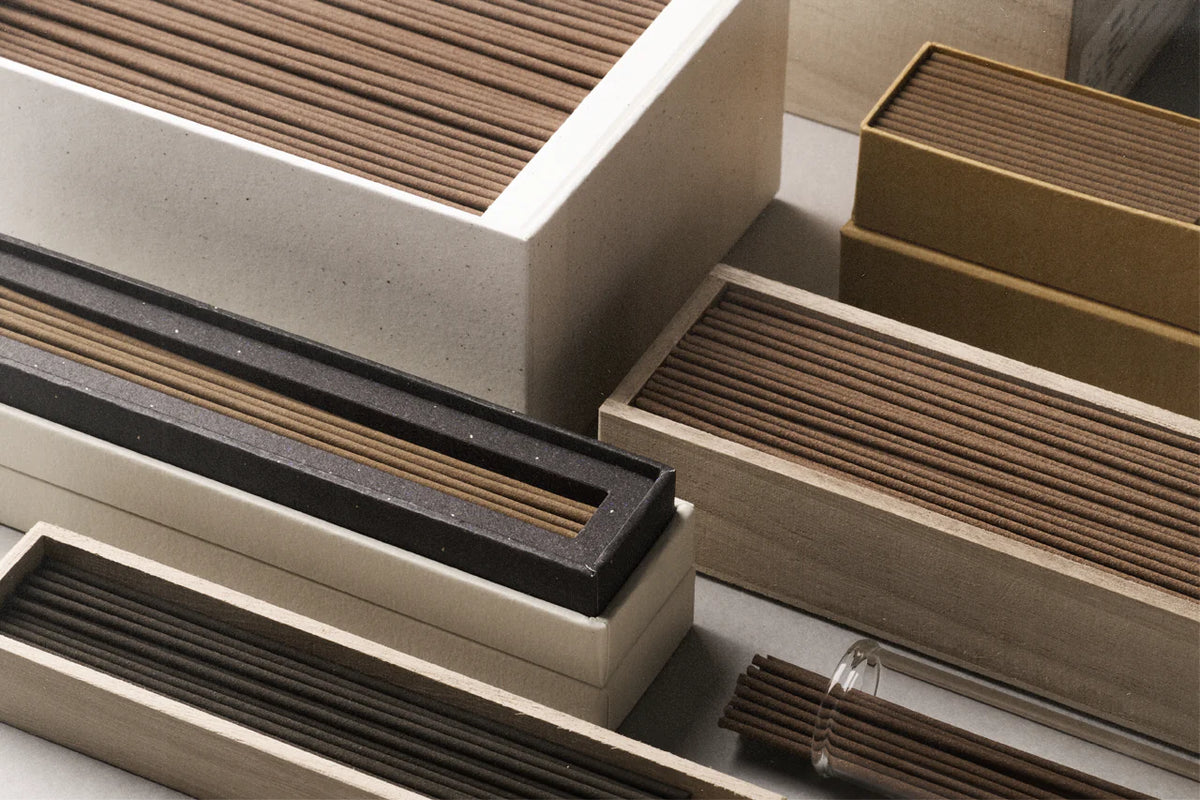

Incense storage remains routinely overlooked within both the incense community and the broader industry. In practice, working daily with aromatic formulations reveals how significantly conditions of storage can alter olfactory outcomes. Daniel, known to most as Dan, has spent the better part of several years at Atmosphere Laboratory working on the storage and archival of incense and aromatic raw materials. Here, he offers practical preservation parameters while deconstructing common myths about incense storage.
Q: Is there, at a fundamental level, a single optimal protocol for storing incense?
Dan: Yes and no. It’s a nuanced subject that depends on the formulation itself, the ingredients involved, as well as the local climate. That said, those considerations belong more to a professional setting. For everyday home use, it shouldn't sound more complicated than it actually is: most incense can simply be kept in a cool, dry place away from direct sunlight. This way, a box of incense should remain perfectly fine for daily use through its lifespan.
Q: For the curious, and the pedantic, how nuanced does professional incense storage actually get?
Dan: Certainly. Atmosphere is based in Singapore, where the climate is consistently hot and humid, with relative humidity (RH) levels often over 80% all year round. Under these conditions, incense and many powdered aromatic materials can rapidly lose their structural integrity and become highly susceptible to mould growth.
Therefore, all incense and materials at Atmosphere are stored within dedicated facilities with controlled temperature and humidity. Certain formulations, such as the Autonym Ambient Incense, also require a prolonged maturation period before they are ready for release. In these cases, we need to precisely regulate the storage conditions to manage the chemical evolution of the scent profile, retaining all intended fragile top notes while allowing the unwanted harsher odours from freshly harvested herbs and spices to mellow out.
Q: Does that mean, by extension, that the lower the humidity is, the better it is for storing incense?
Dan: Not necessarily. If the RH drops too low, around below 35%, many incense formulations will become brittle and crack over long-term storage. Ideally, you want to maintain a consistent, controlled microclimate of RH between 40-50, because humidity fluctuations also play a role. If a material repeatedly swells and contracts in response to changes in moisture levels, it may compromise the olfactory outcomes. This is exactly why, for the long-term preservation of rare pieces like Kyara, we recommend consulting a specialist rather than attempting at home without prior experience.
Q: For those living in humid regions like Southeast Asia with no access to professional facilities, what practical steps can be taken to preserve the incense and protect against mould growth?
Dan: There are a few simple methods. First, keep incense away from areas such as above the kitchen, inside bathrooms, or near windows where exposure to humidity tends to be higher. Second, some ventilation is beneficial in preventing stagnant moisture buildup within the incense box.
There is, in my view, a persistent misconception among both retailers and users who store incense in ziplock bags or airtight containers such as test tubes. This is a hard no for me personally, and for Atmosphere as a protocol. You will not find any airtight packaging at Atmosphere, as it can trap moisture and increase the risk of mould growth.
Instead, we always recommend porous storage mediums like standard cardboard or, ideally, a paulownia wooden box, which naturally regulates moisture while helping to retain the scent over time. If you want a bit of extra insurance, small silica gel packs may absorb any excess moisture in small incense storage boxes.
Q: Wouldn’t a silica gel pack also absorb scent and strip incense of its fragrance over time?
Dan: No, this is another myth we frequently encounter through our daily interactions with clients at Atmosphere. I’ve seen this myth circulated across social media, blogs, and even brand pages. Chemically, however, this is fundamentally incorrect.
To put it in the simplest (and slightly reductive) terms, you can imagine silica gel as a specialised form of silicon dioxide (SiO₂) with a massive network of microscopic pores. The walls of these pores are lined with specific chemical groups called silanols (Si–OH), which are really good at “trapping” water. Because these pores are optimised for the tiny size of water molecules, they are completely mismatched for the large, complex, and bulky molecular structures of aromatic compounds. With strong hydrogen bonding, water molecules will always outcompete those larger compounds to bind with the Si–OH. So yes, you can safely use silica gel packets with your incense without stripping away the scent profile.
Q: Given perfect storage conditions, how long can incense be stored?
Dan: Perfect conditions are always relative. That said, all else being equal, the specific formulation of an incense dictates its true shelf life. Formulas that rely heavily on highly volatile essential oils, like citrus, lose their scent fairly quickly. In fact, if they are sealed too tightly in airtight packaging, like those we discussed earlier, it may trigger autoxidation which causes that stale, sour, or 'rancid' smell you often notice in old essential oils.
From my time working with Atmosphere perfumers, I’ve learned that certain delicate floral absolutes and ground powders can undergo significant olfactory changes in a matter of just a few months. On the other end of the spectrum, materials like Agarwood can be aged for decades. So to give an accurate timeline, we have to analyse the full formula of each blend.
Take a creation like Autonym Ambient Incense, for example, it is intentionally formulated to age for over 5 years. As such, its formulation relies heavily on dense base materials like Vetiver, Patchouli, and Sandalwood which, by nature (and within a blend), can gradually reach a state of chemical equilibrium and smell better over time.


