


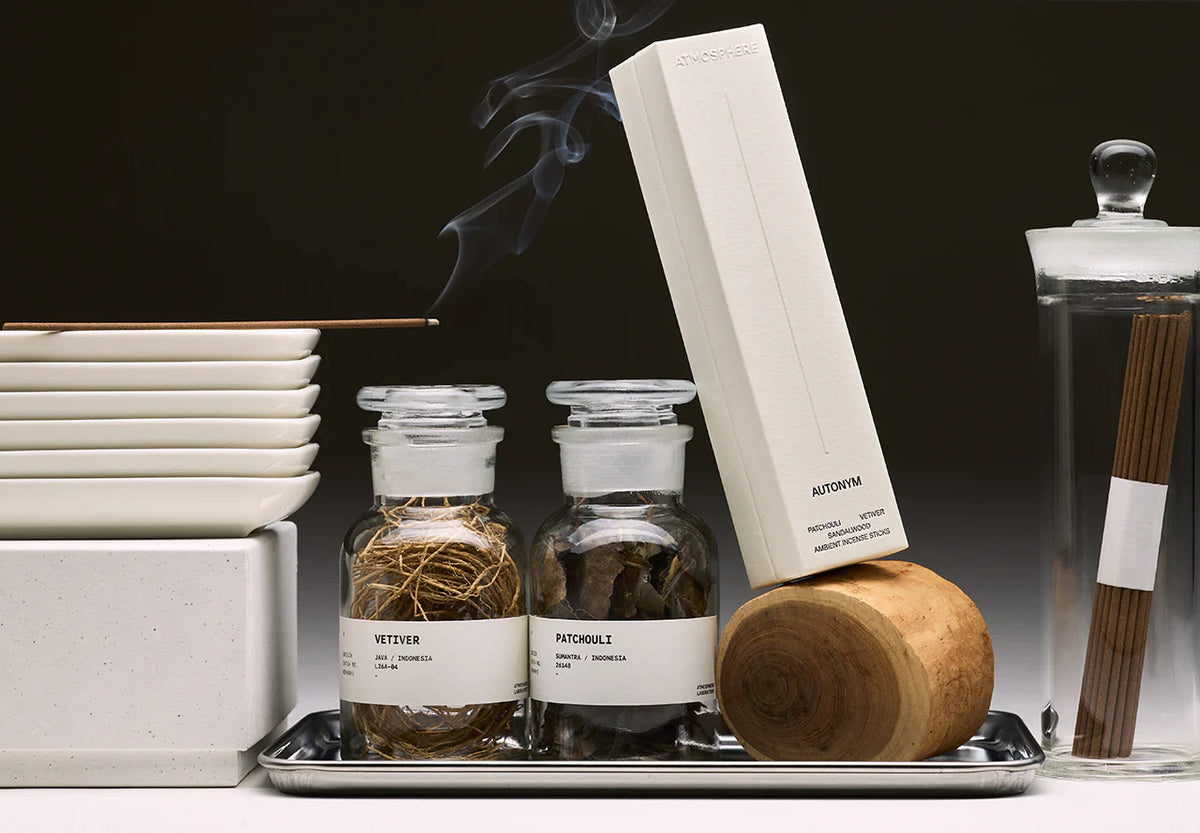

Formulating a Sandalwood incense is a fairly simple task. Yet within the extensive body of incense works spanning centuries and cultures, Sandalwood has been interpreted in countless ways—some iconic, others lesser known. Thus, pursuing a contemporary expression of Sandalwood that is not deemed redundant within prior creations demands extensive experimentation and sustained effort. For us, this process took four long years.
This journal documents 3 primary challenges we set for ourselves prior to and during the formulation of Autonym Ambient Incense, which significantly influenced its olfactory outcomes.
Challenge 1: Navigating the Balance Between the Old and the New
Our deliberate choice of Sandalwood as the primary subject presents a challenge in itself. We adopted Sandalwood for its familiarity, its versatility, and for its overwhelming presence in countless creations throughout the history of incense, ever since its height during the Tang dynasty. Yet we also recognized, intuitively, a vast potential that remains largely untapped. Our guiding question, then, is: what comes next for Sandalwood?
Our direction is never to alter Sandalwood to the point of being unrecognizable, nor do we rely on it in its raw form alone. We also refrain from postmodern methods of crafting Sandalwood accords that feel overly abstract. Instead, we experimented with ground Sandalwood powder and its distilled oil in varying ratios to form a base, which we then gradually modified through microdoses of other aromatics, step by step, until it emerged as something entirely new, an entity with a life of its own, yet never straying far from what one expects of Sandalwood. Think of it as a sculptor approaching a raw block of wood, shaping it day by day, guided by vague intuition rather than a detailed sketch.
Challenge 2: Olfactory Presence of the Smoke
In many traditional and contemporary incense formulations, smoke is commonly treated as a vehicle to disperse aroma through the air. Its own olfactory character is often overlooked, and if noticed at all, it is frequently regarded as a flaw to be masked rather than an element to embrace.
In the formulation of Autonym Ambient Incense, we regard smoke as a raw material in its own right. Our methodology, therefore, is structured around experiments with aromatics of varying profiles and flash points, selecting those that integrate seamlessly with the smoke to form a harmonious accord when burned. We recognize this as an exceptional trait of incense, one that cannot be replicated by any other olfactory form or medium.
Challenge 3: A Respect for Longevity
A great part of studying a scented formulation, or a raw material, is observing how it evolves over time: fresh out of the lab, after a month, a year, five years, and beyond. With this in mind, we intentionally formulated Autonym Ambient Incense to allow for the possibility of gradual maturation under appropriate storage conditions. Accordingly, many commonly used raw materials, particularly volatile top notes, were deemed unsuitable from the outset due to their tendency to degrade rapidly.
Instead, we relied on a substantial proportion of wood powders, ground spices, resins, and base note materials rich in sesquiterpenes, which have demonstrated the capacity to evolve aromatically over time in a desirable manner. This deliberate restriction in our palette also shapes the overall olfactory identity of our work, resulting in an earthy, resinous, and woody prominence that continues to deepen over time.
Autonym Ambient Incense documents our internal dialogue between material, method, and our subjective artistic direction within a broader historical context. As we navigated this inaugural formulation in the lab, each decision—what to include, what to restrain, and how to modulate—reflected a deliberate consideration of both inherited knowledge and our contemporary understanding of what constitutes a ‘good’ scented formulation


